
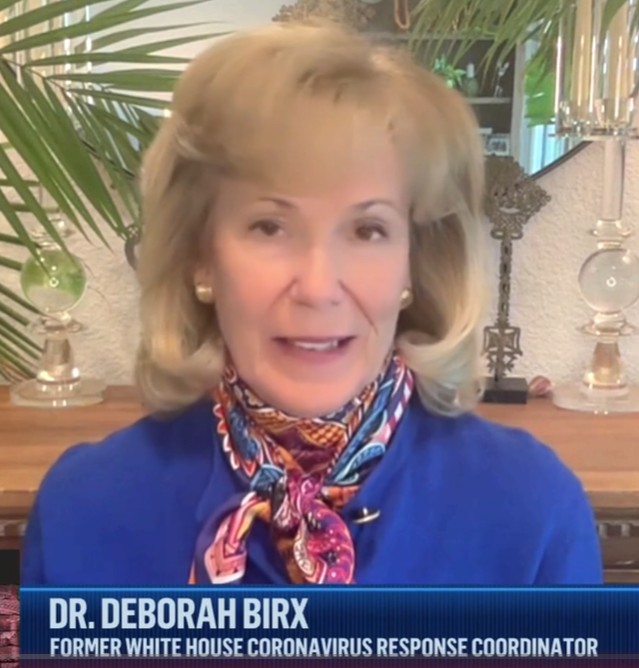
Dr. Deborah Birx spent the better part of two years standing three feet from Anthony Fauci at White House press briefings, nodding along to every recommendation he made, occasionally gesturing at charts that reinforced his conclusions. Matching scarves. Coordinated messaging. A unified front of "follow the science."
That was then. Now she'd like you to know this was mostly his fault.
In the wake of Fauci's catastrophic appearance before the Senate Committee on Homeland Security and Governmental Affairs — where the former NIAID Director invoked the Fifth Amendment 111 times — the former White House COVID Task Force Coordinator is doing what Washington insiders do best: sprinting for the lifeboats while the ship is still making noise.
"There were solutions, but it became very political, and we all have to be aware, because it was a presidential election year," Birx said, framing the pandemic response failures as something that happened around her rather than through her.
Then came the real tell.
"It was really important for blue states to show that they were taking this very seriously, and they overclosed," Birx said.
So blue states "overclosed." That's an interesting word from a woman who was the White House COVID Task Force Coordinator — not an observer, not a commentator, the coordinator. She wasn't watching blue states overclose from the bleachers. She was on the field. She helped draw up the plays.
Fauci just pleaded the Fifth 111 times before a Senate committee, seven states have filed accusations against pandemic-era officials — charges that include medical coercion and racketeering — and suddenly Birx discovers she was actually the reasonable one all along. The task force she coordinated included Dr. Rochelle Walensky at the CDC, Dr. Francis Collins at NIH, Dr. Stephen Hahn and Dr. Janet Woodcock at the FDA, and Dr. Cliff Lane as Fauci's deputy at NIAID. That's the team she was quarterbacking. But now, apparently, the quarterback had nothing to do with the game plan.
The admission about blue states overclosing is worth pausing on — not because it's wrong, but because of who's saying it. Birx is acknowledging that lockdown decisions were driven by political signaling rather than public health. States closed not because the data demanded it, but because it was "really important" to look like they were taking it seriously during an election year. That's not a medical assessment. That's a campaign strategy that shuttered businesses and isolated elderly people in nursing homes.
Birx isn't wrong that it became political. She's wrong about her role in it becoming political. You don't get to coordinate the response, stand at the podium endorsing the policies, watch millions of Americans lose their livelihoods, and then years later say the problem was that things got too political. You were the politics.