
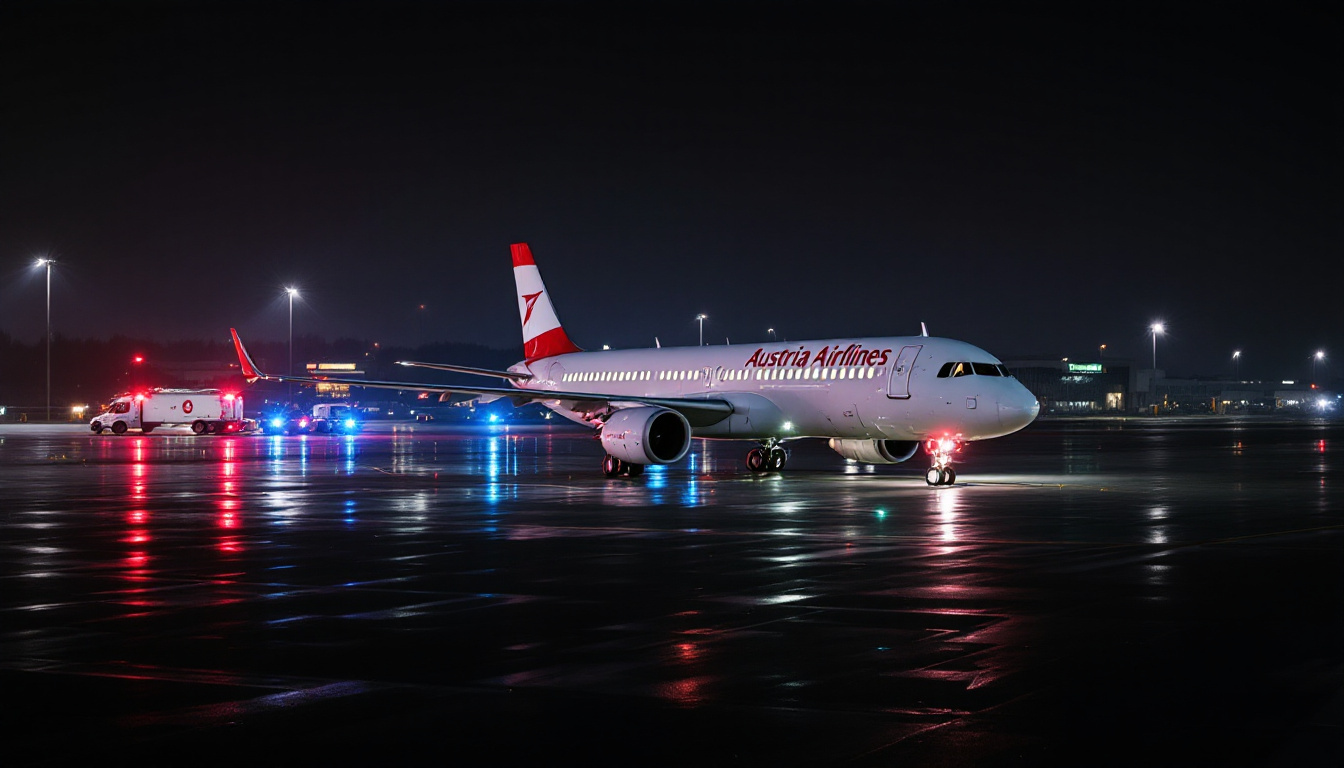
At 8:42 p.m. Central European time on Saturday, Austrian Airlines Flight OS82 dropped out of the sky over Bulgaria, its transponder screaming Squawk 7700 — the universal aviation distress code. Fifty-seven people were on board. Fifty-one passengers and six crew members who'd taken off from Ben-Gurion Airport in Tel Aviv headed for Vienna and ended up evacuating on the tarmac in Sofia instead.
Somebody had called in a bomb threat.
Austrian Airlines confirmed the diversion in a statement reported by 100 Percent Fed Up: "We can confirm that a threat was made against flight OS82 from Tel Aviv to Vienna, which necessitated a stopover in Sofia." The airline added, "The safety of our passengers and crew is always our top priority."
The threat came by telephone to Vienna airport — a "bomb threat signal" that triggered an immediate reroute to Sofia Airport in Bulgaria, the nearest viable landing option. The aircraft was searched. The passengers were searched. The crew was searched. Austrian Airlines reported the outcome: "During the search of the affected aircraft, the passengers, and the crew, no danger was identified."
No device was found. That's the good news.
The bad news is that someone specifically targeted a commercial flight leaving Israel. Not a random route. Not a domestic European hop. A plane full of people departing Tel Aviv. Austrian Interior Minister Gerhard Karner acknowledged the incident as authorities investigated the source of the threat.
This isn't happening in a vacuum. The threat against Flight OS82 comes at a time when aviation security around Israel-connected routes has been under intense scrutiny. Just recently, a FlyDubai flight carrying 170 passengers faced its own security scare. The pattern isn't subtle. Flights connected to Israel keep drawing threats, and the question nobody in charge seems eager to answer is whether the people making those calls are getting closer to following through.
The hoax theory is the comfortable one. A prank caller, a false alarm, everyone goes home. And maybe that's what this was. But you don't transmit Squawk 7700 and divert an aircraft carrying 57 souls to a foreign country's runway because you're feeling cautious. You do it because the protocols exist for a reason, and the reason is that the threats aren't always fake.
What stands out is how little attention this got. A commercial airliner from Israel emergency-lands in Bulgaria because of a bomb threat, and it barely cracks the news cycle. We've apparently reached the point where "bomb threat against flight from Tel Aviv" is just another Saturday.
Austrian authorities are investigating the origin of the telephone threat to Vienna airport. No arrests have been announced. The passengers eventually continued to Vienna after the all-clear.
Fifty-seven people sat on a tarmac in Sofia wondering if their plane was about to explode. The plane was clean. The next one might not be.