
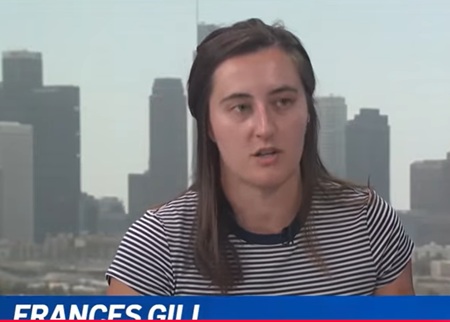
Frances Gill, a member of the Democratic Socialists of America's National Political Committee, sat across from NBC 4 Los Angeles anchor Conan Nolan last week and was asked the simplest question in the history of criminal justice policy. Nolan put it plainly: "So if my daughter is assaulted and raped, is there any agency that would seek to find her assailant and bring him to justice?"
Gill's response started with "Of course, yeah, of course—" and then went nowhere.
Nolan pressed. "What would it be if not police, and where would he be if not a jail?" This is a woman whose organization's official platform calls for defunding police and eliminating jails entirely. Not reforming. Not restructuring. Abolishing. And when asked the single most predictable follow-up question on planet Earth, she folded like a card table.
"So I guess I really want to avoid getting caught into these hypotheticals and talk about the reality that we're actually facing right now," Gill told Nolan, pivoting to inadequate streetlights, substance abuse treatment, and mental health care as the real roots of crime. Because when a violent predator attacks your daughter, the real problem was insufficient municipal lighting.
This is the DSA's pitch to America in 2026. The exchange went viral just as DSA-aligned candidates are surging in Democratic primaries nationwide. Abdul El-Sayed, a DSA-adjacent candidate, just won the Michigan Senate primary. DSA Co-chair Megan Romer told Fox News Sunday that the organization backs abolishing prisons, ICE, and national borders as a long-term plan. Not as some aspirational thought exercise — as the actual platform.
Gill, who reportedly carries $500,000 in student debt, wants to redesign the entire American justice system from scratch. She just can't tell you what the new one looks like. Not even the broad strokes. Not even when the question is "where does the rapist go."
The DSA crowd will say Nolan's question was a gotcha. But asking a prison-abolition advocate what happens to violent criminals isn't a trap. It's the first question any voter would ask. It's the question that should be answered before you print the campaign signs, not after a news anchor corners you on live television.
El-Sayed's Michigan win drew heavy support from college-educated voters. He lost counties where most voters lacked degrees. There's a pattern forming: the abolish-everything platform plays well in faculty lounges and poorly in neighborhoods where people actually worry about getting home safe.
Watch Gill's exchange for yourself