
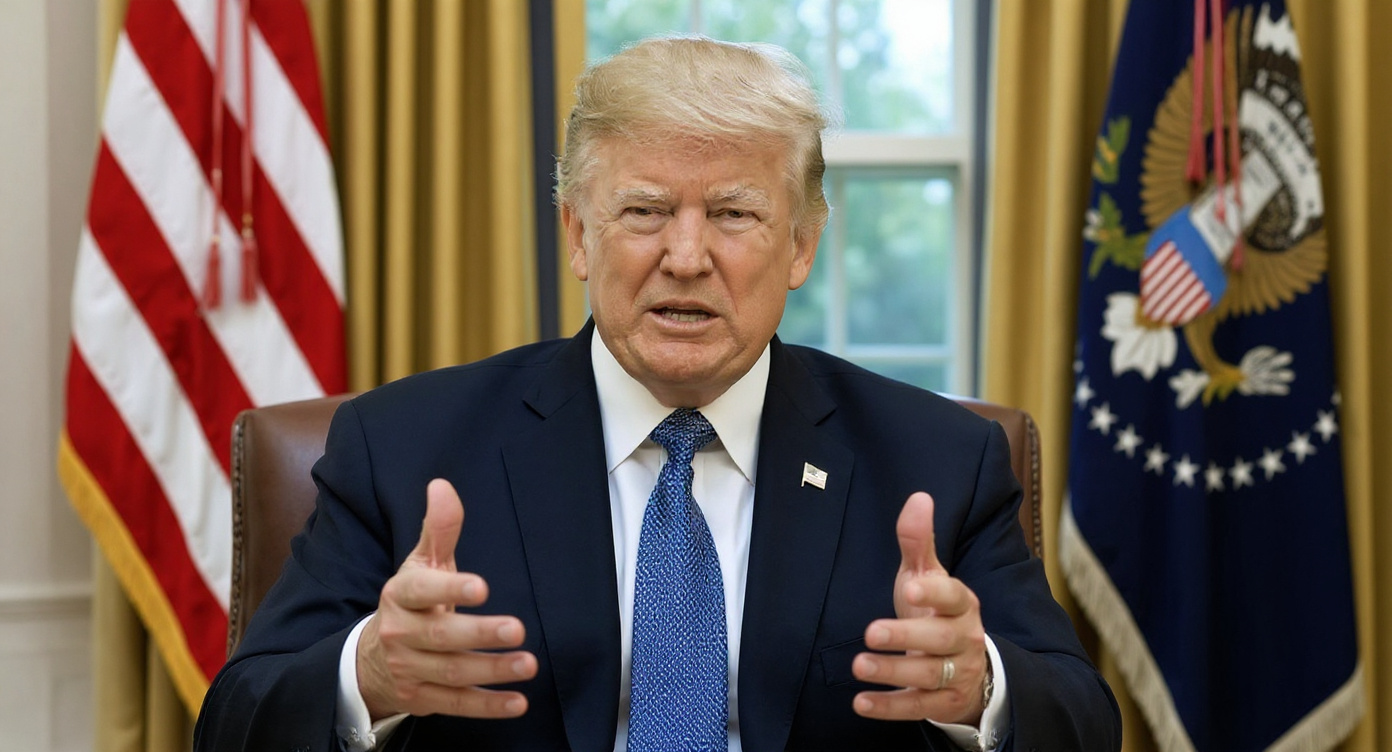
"If it does happen, we wipe them out."
That's President Trump on Wednesday, sitting across from Fox News correspondent Jacqui Heinrich, responding to intelligence reports that Iran has been exploring biological and chemical weapons programs now that its nuclear ambitions have hit a wall. Five words. No caveats. No diplomatic exit ramp.
The last two administrations gave Iran pallets of cash and phone calls begging for meetings. This one gave them a sentence.
Trump's comments came after CNN reported, citing seven unnamed U.S. officials, that Iran had been developing plans for a possible dirty-bomb or chemical-weapons attack targeting Washington, D.C. — with two sources describing plans that included specific locations and targets aimed at senior Trump administration officials. The president didn't flinch at the report. He leaned into it.
"There is indication that Iran is looking at gases, looking at the bio, because we've shut them," Trump told Heinrich, referencing how U.S. pressure has curtailed Tehran's nuclear program and apparently pushed the regime toward alternative weapons development. When pressed on whether he meant what he said — whether "wipe them out" was the actual policy — Trump didn't walk it back. "Oh, I give you my word. Absolutely."
That exchange is worth reading twice, because the question itself tells you how rare this kind of clarity is in American foreign policy. A reporter asked the President of the United States if he really meant his own words. He confirmed them without blinking.
Trump also referenced a timeline. "We'll see, we have a new year coming up and we'll see what happens after January 1," he said — framing a de facto deadline that Tehran now has to factor into its calculations. Not a "strategic review." Not a "multilateral framework." A date on the calendar and a consequence attached to it.
White House spokeswoman Lauren Bis told the Daily Wire that the administration is "monitoring any and all potential threats, but at this time there are no credible threats." That's the standard language. The non-standard part was the president going on camera and spelling out what happens if monitoring turns into something else.
"Nobody's going to play games with us," Trump added.
The timing matters. These remarks landed while Trump was engaged in high-stakes diplomacy with China and Russia — meaning the Iran statement didn't happen in a vacuum. It happened on a stage where Beijing and Moscow were watching. Every foreign ministry on earth heard those five words at the same time.
Compare this to the last eight years of Iran policy before Trump's return. The Obama administration negotiated the JCPOA, shipped $1.7 billion in cash to Tehran, and treated the mullahs like misunderstood partners who just needed the right incentive structure. The Biden administration spent its tenure trying to resurrect that same deal while Iran's proxies launched attacks across the Middle East. The operating theory was that if you're nice enough, theocratic regimes with "Death to America" murals on government buildings will come around.
Trump's theory is different. You tell them what happens, and you mean it.
There's a reason deterrence works when it's credible and fails when it isn't. Iran watched the Obama years and concluded America would pay them not to build weapons. They watched the Biden years and concluded America would negotiate while they built them anyway. Now they're watching a president say — on camera, to a reporter, confirmed twice — that the consequence is annihilation.
The foreign policy establishment will spend the next week explaining why this kind of language is "dangerous" and "destabilizing." These are the same people who stabilized Iran right into a biological weapons research program.
Five words. No asterisk. January 1 is ten weeks away.