
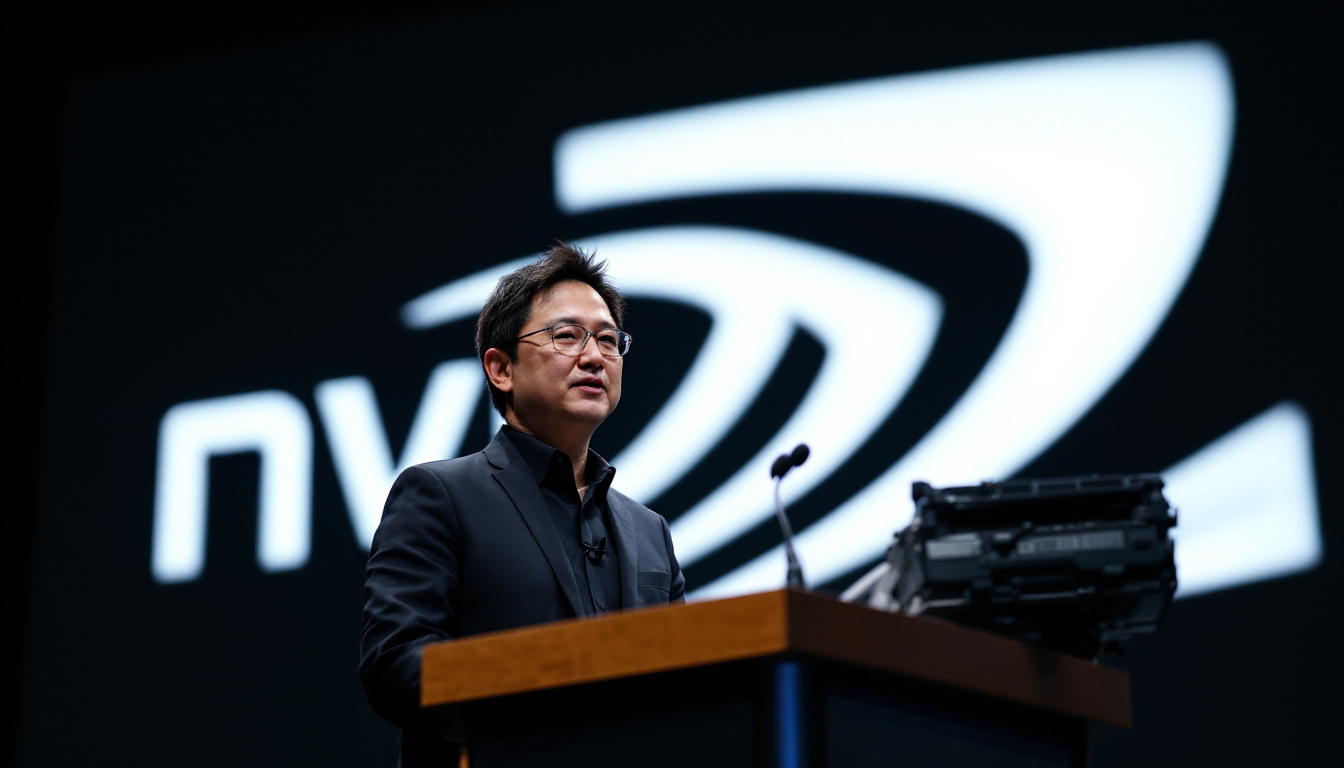
Jensen Huang, the co-founder and CEO of Nvidia, issued a public statement last week apologizing to his wife Lori and their two children for being "unfaithful." What he did not apologize for — or directly address — was the FBI investigation into whether the woman he was photographed with at Nvidia's GTC Berlin conference in October was running a Chinese honeypot operation against him.
Her name is Alice Huang. She's an executive at a Singapore-based data center company called Megaspeed. And according to reporting by the New York Times, U.S. intelligence agencies have evidence she was passing information to Beijing.
The photos surfaced from GTC Berlin, taken between October 20 and 22. Jensen Huang and Alice Huang — no relation, for the record — appeared together in what the New York Post described as "loved-up" images. Weeks later, Jensen Huang was lobbying President Trump to relax chip export restrictions to China. The man running America's most strategically important AI company was cozying up to an accused foreign intelligence asset and then walking into the White House to argue we should sell Beijing our best technology.
Nvidia shares fell nearly 5% on Monday after the board announced an internal investigation Sunday night. The board's official position: they found "no reason to believe" that national security or company secrets were compromised. Which is one of those statements that sounds reassuring until you remember the FBI is still actively investigating.
President Trump weighed in Monday from Air Force One. "I just know he's a fine person but you never know what is happening," Trump told reporters. "I hope everything is fine there. He's accomplished so much." At a press briefing later that day, Trump added: "He said I had no idea that she was a spy, and I really believe him."
Trump's tone was notably measured — acknowledging Huang's contributions while leaving room for the investigation to play out. "I think he's an honorable guy, I think he probably has an excuse for it… he's accomplished amazing things for our country," the President said.
Huang's own public statement was surgically limited. "I owe my family and all of you an apology. I was unfaithful to my wife. My actions hurt her and our children. There is no excuse for what I did. I am deeply sorry," he wrote. Then the pivot: "I love our country and our company. I am committed to protecting NVIDIA and supporting America's national security."
Notice the structure. He admitted the affair. He expressed commitment to national security. What he conspicuously did not do was address the espionage allegations directly. His only comment on the Megaspeed connection came last month to Bloomberg, where he described his interactions with Alice Huang as "related to Megaspeed, and it was all completely normal and not unusual."
Completely normal. The CEO of America's most critical AI chipmaker — a company whose technology is so strategically vital that we restrict its sale to China — was having a relationship with a woman the FBI suspects of spying for Beijing. And his explanation is that it was "not unusual."
Jensen Huang married Lori Huang in 1985 after meeting her in an electrical engineering class at Oregon State University. Both of their children, Madison and Spencer, work at Nvidia. This is a man whose entire personal and professional life is woven into a single company that sits at the center of the U.S.-China technology competition.
The lobbying timeline is what makes this more than a personal scandal. The photos with an accused spy came first. The push to loosen chip restrictions to China came after. Maybe that sequence is a coincidence. Maybe a man running a $150 billion company just happened to advocate for policies that would benefit the country whose intelligence services allegedly targeted him, right after spending time with the woman they allegedly sent.
The FBI investigation is ongoing. Nvidia's board says everything is fine. Jensen Huang says everything was normal.
He apologized for the affair. The espionage question got a Bloomberg quote and silence.