
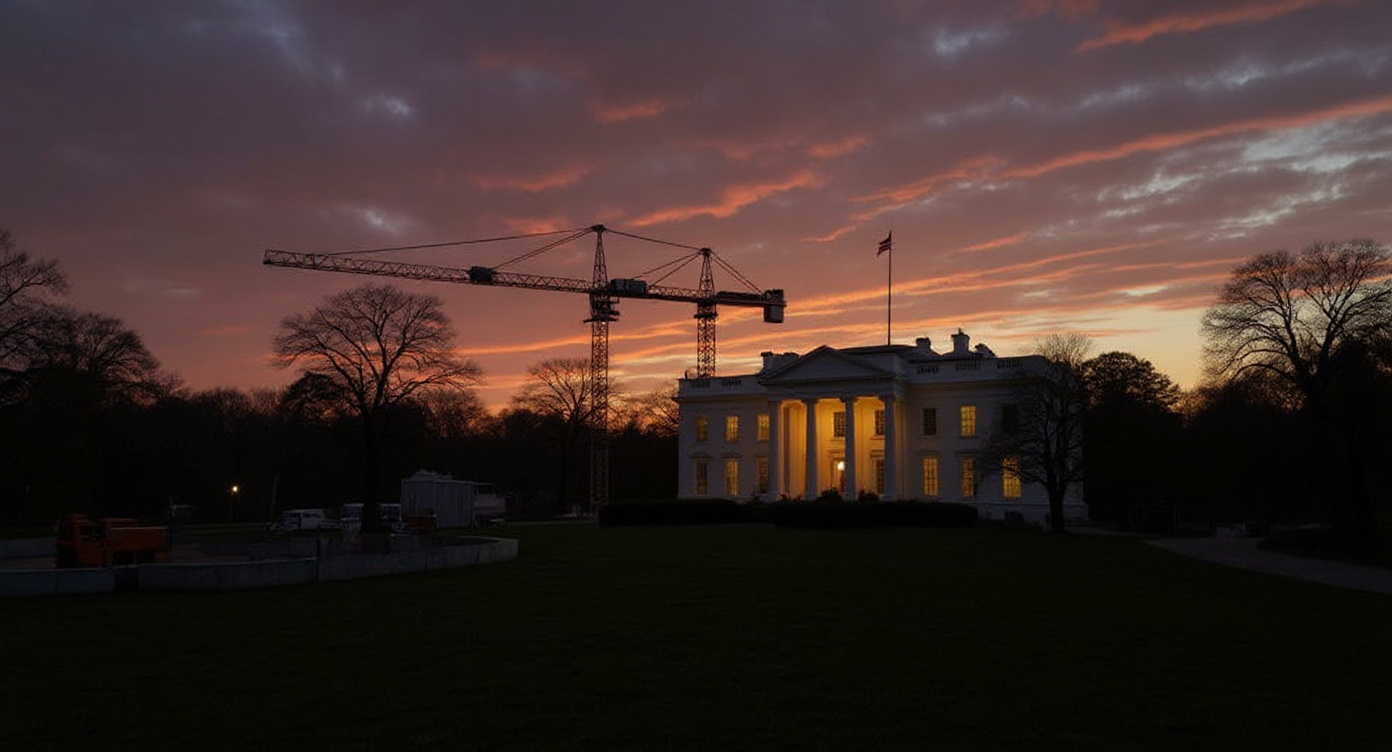
President Trump recently walked a group of reporters through his new White House construction project and, with the casual energy of a man showing off a new garage, revealed it goes six stories underground, contains a military hospital, houses research facilities of unspecified purpose, and features a rooftop drone base capable of launching what he called "unlimited numbers of drones" to defend Washington.
A ballroom. They're calling it a ballroom.
Let's rewind. Back in October 2025, the East Wing got demolished to make way for what was originally billed as a 90,000-square-foot state ballroom — a classy upgrade to the People's House, estimated at around $400 million. Sounded fancy. Sounded elegant. Sounded like a place where you'd waltz with a foreign dignitary while nibbling on shrimp cocktail.
Then Trump opened his mouth, as he beautifully does, and the "ballroom" narrative went right out the four-inch-thick window.
"This goes down very deep," Trump told reporters on May 19th. "That is down about six stories deep. That's big stuff." He described the underground levels as housing a full military hospital, research facilities whose purpose he did not explain, meeting rooms for military operations, and command-and-control centers. The ballroom itself? Trump said the quiet part out loud back in March: "The ballroom essentially becomes a shed for what's being built under the military."
A shed. The man called his own ballroom a shed for the real project underneath.
The roof isn't just a roof either. Trump described it as hosting "the greatest drone empire you've ever seen that's going to protect Washington," engineered so that "if a drone hits it, it bounces off." He even added: "I hate to use the word snipers, but we have great sniper capacities built for our snipers." The man hates to use the word, then uses it twice.
Now here's where it gets interesting — and we mean that in the best possible way.
Take a look at who's funding this thing. The White House released a donor list that reads less like sponsors of a state dinner venue and more like a who's who of people with access to information the rest of us aren't cleared for. Google. Meta. Apple. Amazon. Microsoft. Nvidia. The Winklevoss twins. And — this is the part worth sitting with — a significant number of donors asked to remain anonymous. A watchdog group had to sue just to confirm they exist.
These are the companies that control what you read, what gets censored, what gets amplified, and what gets quietly buried. Every major gatekeeper of modern information quietly cut a check for a six-story underground complex beneath the White House. According to OpenSecrets, these same donors are "poised to benefit from an AI plan they helped shape." So they fund the fortress and get favorable AI policy in return.
The question worth asking isn't why Trump is building this. Presidential security infrastructure beneath the White House dates back to World War II, when FDR needed a shelter under the East Wing. The concept is 80 years old. Trump is modernizing it — ambitiously, and with the subtlety of impenetrable steel — but underground presidential security is older than most of the senators currently trying to block the funding.
The question worth asking is why these people are paying for it.
Google, Meta, Apple, and Amazon didn't write nine-figure checks for a ballroom. They wrote them for something that goes six stories deep, houses a military hospital, and contains research facilities that the President of the United States declined to describe to the press. And many of the other donors asked not to be named at all.
When the people who control information start quietly funding an underground fortress — and asking not to be identified for doing so — you're allowed to wonder what conversation is happening in rooms the rest of us aren't invited into.
Trump called it a "shield."
A shield against what? He didn't elaborate. The research facilities three floors below the dance floor aren't talking either. But the people who decided to fund those floors — the ones who know everything about everybody — apparently decided this was worth their money.
That's the detail nobody's asking about.
Maybe it's nothing. Maybe they just wanted a tax write-off with very thick walls. Or maybe the people with the most access to the most information on earth decided, quietly and without much fanfare, that having a fortified underground complex in Washington was a reasonable thing to invest in right now.
Sleep well.